
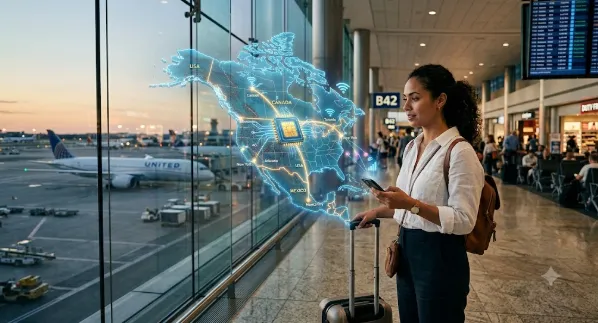
Venturing across the vast and varied landscapes of North America – from the bustling metropolises of the United States to Canada’s serene wilderness and Mexico’s vibrant coastlines – is an unforgettable experience. However, staying connected without incurring exorbitant roaming charges can often be a traveler’s hidden headache. Traditional SIM cards require physical swapping, risking loss and hassle, while relying solely on Wi-Fi limits your freedom. Enter the eSIM: a revolutionary digital solution that is transforming how we stay in touch abroad. For anyone planning a trip across the continent, understanding and utilizing an eSIM is no longer just a convenience; it’s a strategic move towards a truly seamless and stress-free journey.
What Exactly is an eSIM and Why is it Ideal for North America?
An eSIM, or embedded SIM, is a small chip built directly into your smartphone or other compatible device. Unlike a traditional physical SIM card that you insert and remove, an eSIM is programmable. This means you can download and activate a cellular plan digitally, without needing to handle tiny pieces of plastic. The beauty of an eSIM for North America lies in its flexibility and instant activation. Imagine landing in New York, then heading to Toronto, and finally relaxing in Cancún, all while maintaining connectivity on a single, integrated plan. This eliminates the need to hunt for local SIM cards in each country, navigate unfamiliar languages to activate them, or deal with the frustrating surprise of hefty international roaming fees from your home provider.
Furthermore, an eSIM allows you to have multiple profiles stored on your device simultaneously. You can keep your home number active for important calls or texts while using a separate eSIM profile for all your data needs. This dual-SIM functionality is incredibly practical, ensuring you never miss a critical message from home while enjoying affordable local data rates. For the extensive travel that North America often entails, with its vast distances and multiple national borders, an eSIM provides unparalleled ease and peace of mind.
Choosing the Right eSIM Plan for Your North American Adventure
Selecting the perfect eSIM plan requires a bit of foresight to match your travel itinerary and data usage habits. First, consider the duration of your trip and the specific countries you’ll be visiting. Are you spending a week in the US, a month hopping between Canada and Mexico, or a quick border-crossing trip? Many eSIM providers offer regional plans that cover multiple countries, often including the US, Canada, and Mexico under one umbrella. This is usually the most convenient and cost-effective option for multi-country itineraries. For example, to ensure continuous, affordable connectivity across all three major North American destinations, consider a North America travel eSIM that bundles these countries. Carefully examine the data allowance. Are you a heavy streamer, or do you just need data for maps, messaging, and occasional browsing? Plans range from a few gigabytes to unlimited data, each with different price points. Factor in whether you need voice calls and SMS. While many travelers rely on Wi-Fi calling and messaging apps, some prefer traditional calling capabilities, which some eSIM plans include.
Always check the network coverage details provided by the eSIM vendor. While most reputable providers partner with major local carriers, coverage can vary in remote areas. A quick look at their coverage maps can save you from unexpected dead zones. Finally, compare pricing structures. Some plans offer daily rates, others are valid for a set number of days regardless of usage, and some are pay-as-you-go. Read reviews and look for transparent pricing with no hidden fees.
Activating Your eSIM: A Simple Step-by-Step Guide
The activation process for an eSIM is surprisingly straightforward, usually taking just a few minutes. Before you depart, ensure your smartphone is eSIM-compatible and unlocked by your home carrier. Most modern flagship phones from Apple, Samsung, Google, and others support eSIM technology. Once you’ve purchased your eSIM plan online, you’ll typically receive a QR code via email or within the provider’s app. You can either scan this QR code directly from your device’s settings or manually enter the details provided.
Here’s a general activation sequence: Go to your phone’s settings, navigate to ‘Cellular’ or ‘Mobile Data,’ and look for an option to ‘Add eSIM’ or ‘Add Data Plan.’ You’ll then be prompted to scan the QR code. Your phone will download the eSIM profile, and you can give it a recognizable label, like ‘North America Travel’ or ‘US Data.’ Once added, ensure you’ve selected your new eSIM for mobile data and, if applicable, for voice and messages. Crucially, turn off data roaming for your primary (home) SIM to avoid any accidental charges. It’s often best to perform this activation before you leave home, connected to Wi-Fi, so you land with instant connectivity.
Maximizing Your eSIM Experience and Troubleshooting Tips
To get the most out of your eSIM in North America, proactive management is key. Monitor your data usage regularly through your phone’s settings or the eSIM provider’s app. This helps you avoid running out of data unexpectedly, especially if you’re exploring areas with limited Wi-Fi. If your plan allows, consider topping up data in advance rather than waiting until you’re completely out. For heavy data users, utilizing Wi-Fi whenever available – at your hotel, cafes, or public hotspots – can significantly extend your plan’s life. Remember to disable background app refresh for non-essential apps and turn off auto-download for media to conserve data.
Should you encounter any connectivity issues, don’t panic. First, try restarting your phone. Often, a simple reboot can resolve minor glitches. Double-check your phone’s settings to ensure the correct eSIM profile is selected for data and that mobile data is turned on. Verify that data roaming is disabled for your home SIM and enabled (if required by your eSIM provider, though many don’t require it) for your travel eSIM. If problems persist, consult the troubleshooting guide provided by your eSIM vendor or reach out to their customer support. Providers like Cellesim often have dedicated support teams available to assist with activation or connectivity challenges, ensuring you’re never truly alone in a foreign land.
The Future of Connectivity: eSIMs and Beyond
The rapid adoption of eSIM technology marks a significant shift in global connectivity, moving us further away from the physical constraints of traditional SIM cards. For North American travelers, this means more freedom, greater flexibility, and the ability to customize their mobile experience like never before. As more devices become eSIM-compatible and competition among providers grows, we can expect even more innovative and affordable plans to emerge, catering to every type of traveler and itinerary. The convenience of switching between plans with a few taps, managing multiple country profiles, and instantly connecting upon arrival makes eSIMs an indispensable tool for the modern explorer.
Ultimately, embracing eSIM technology for your North American travels isn’t just about saving money on roaming; it’s about simplifying your journey, enhancing your safety, and ensuring you’re always just a tap away from maps, translation apps, emergency services, or sharing those incredible travel moments with loved ones. It’s a small change in your travel planning that yields immense benefits, letting you focus on the breathtaking sights and sounds of the continent rather than worrying about your phone bill.