
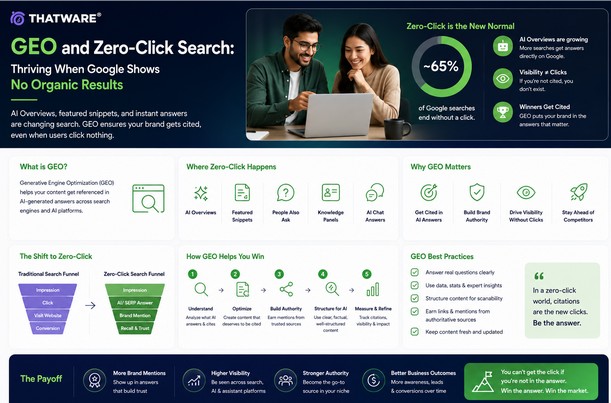
There’s a version of this conversation that ends with despair. Google shows an AI-generated answer at the top of the page. The user gets what they need without scrolling further. Nobody clicks. Traffic doesn’t materialize. The organic results that used to drive visits are effectively invisible to a large share of queries. If your business model depends on organic search traffic, this trend is uncomfortable to look at directly.
But here’s the reframe that changes the calculus: zero-click doesn’t mean zero value. It means the value has moved — from the click to the citation. And brands that understand this shift can thrive in a zero-click environment rather than simply losing ground to it.
This is one of the more important strategic conversations in digital marketing right now, and GEO is at the center of it.
Understanding the Zero-Click Shift
Zero-click search has been growing for years. Even before generative AI, featured snippets and knowledge panels were answering questions before users ever reached organic results. AI Overviews in Google Search have accelerated the trend dramatically — by some estimates, a significant proportion of search queries now result in zero organic clicks.
The categories most affected tend to be informational queries — “how does X work,” “what is Y,” “when did Z happen,” “best way to do W.” These were historically high-traffic content opportunities. Now they’re increasingly answered directly in the search interface, and the traffic simply doesn’t flow through to the underlying websites in the way it used to.
For brands that built their content strategy around informational traffic as a lead generation path — which is a large portion of B2B and consumer content marketing — this requires a genuine strategic adjustment. Not abandonment of content, but a different model for what content is supposed to accomplish.
From Traffic Goals to Citation Goals
The fundamental shift is moving from “how do we get traffic from this query” to “how do we get cited in the answer to this query.”
These goals often overlap — content that gets cited in AI answers also frequently drives some traffic, particularly when users want to go deeper. But they’re not the same, and optimizing for one without considering the other leads to strategy gaps.
GEO vs SEO thinking plays out most clearly here. Traditional SEO success is measured in rankings and traffic. GEO success is measured in citation rate and brand presence in synthesized answers. A piece of content can perform poorly by SEO metrics (low traffic, because the query is now zero-click) while performing well by GEO metrics (high citation rate, brand consistently mentioned in the AI answer).
Reorienting content metrics to include citation presence — even for queries that don’t drive traffic — changes the picture significantly. Content that “isn’t working” by traffic metrics may actually be building the brand presence that influences future consideration.
The Business Value of Zero-Click Citations
If users aren’t clicking, what’s the value? It’s worth taking this question seriously rather than hand-waving it away.
The value operates through several mechanisms:
Awareness and familiarity. A user who sees your brand cited in AI answers three times during their research phase arrives at the eventual decision point with established familiarity. They may not remember the specific queries where they encountered you, but the brand name isn’t unfamiliar when they see it in a sales conversation or on a vendor shortlist. This familiarity effect is well-documented in traditional advertising research and applies here.
Category association. When AI systems consistently associate your brand with a specific category or problem type in their answers, buyers researching that category develop mental associations between your brand and the solution. This is brand positioning through citation, operating at scale.
Authority signals. Being cited in AI answers is, increasingly, a proxy for legitimacy. Brands that appear consistently in category answers are implicitly endorsed by the AI as worth knowing about. This influences buyer confidence in ways that are real even when not directly measurable.
Eventual conversion. Zero-click at one stage of the journey doesn’t mean zero-click throughout. Buyers who encounter your brand in AI answers during early research may eventually search your brand directly, visit your site, and convert — often with a shorter consideration cycle because the AI citation has already done some of the credibility work.
Practical GEO Strategy for Zero-Click Contexts
Thriving in a zero-click environment requires adjusting content strategy in a few specific ways.
Optimize for being cited, not just being found. Content that contains specific, quotable claims, original data, and clear expert attribution is more likely to be extracted and cited by AI systems than content optimized primarily for keyword matching. The two aren’t mutually exclusive, but the emphasis shifts.
Focus on brand mention quality. Not all citations are equal. Being mentioned as a recommended option is more valuable than being mentioned as a comparison point. Being cited by name with a specific strength is more valuable than a generic brand mention. Understanding how your brand is being framed in AI answers — and taking steps to improve that framing through content and entity optimization — matters in a zero-click world.
Build structured content that AI systems can reference. FAQs, clear definitions, structured how-to content, well-organized data — these formats are particularly extractable by AI systems generating zero-click answers.
The Generative Engine Optimization Services Imperative
Here’s the honest strategic reality for brands operating in categories significantly affected by zero-click: the choice isn’t between zero-click and traffic-click. The choice is between being cited in zero-click answers or being invisible in them.
Generative Engine Optimization services that address zero-click environments specifically help brands understand which of their target queries have shifted to zero-click AI answers, which content is currently being cited in those answers, and what needs to change to improve citation rate and brand framing.
This is genuinely a new category of work that didn’t exist a few years ago. And the brands that invest in it while their competitors are still mourning declining traffic metrics will build durable visibility advantages that persist as AI-driven search continues to evolve.
Rethinking What Success Looks Like
The broader shift here is in what digital presence means. For a long time, digital success was measured primarily in traffic — visitors, sessions, pageviews. The underlying goal was always brand visibility, consideration, and conversion, but traffic was the most measurable proxy.
In a zero-click world, traffic is an incomplete proxy. Brand presence in AI-generated answers is increasingly the more important signal — and measuring it requires different tools and different frameworks than what most marketing analytics stacks are built for.
The brands that update their mental model of digital success — and build the measurement and optimization infrastructure to match — will navigate this transition far more successfully than those trying to recover vanished traffic through tactics that no longer fit the landscape.
Zero-click search didn’t end the value of content. It moved where the value lives. The brands that adapt to that shift — that optimize for citation rather than purely for click — are building something more durable than a traffic number.